Tonight’s club meeting had us parachuting into what we call “Fly-Over Country” – that is, locales situated between the wine-producing regions on the east (New York, mainly) and west (California, Washington, Oregon) coasts of the US. Our travels took us to Missouri, Tennessee, Texas and Virginia with the objective of determining whether to schedule a stop-off on our next cross-country trip.
Texas and Virginia
We started out making a blind comparison between a Texas Hills Vineyards 2009 Kick Butt Cab (12.5% alcohol) and a Virginia 2001 Barboursville Vineyards Sangiovese (13.5% alcohol content). We wanted to know two things: (1) could we tell the difference between a cabernet and a sangiovese (the grape used for chiantis), and (2) is it worth going to Texas or Virginia to buy wine?
Wine # 1 had a browner, murkier look to it with definite legs. It did not have a strong or distinct aroma, but we did notice a slightly sour note to its smell. On tasting we found it astringent, and otherwise bland and not very interesting. Some thought it smooth and light like a pinot noir and others found a touch of plum. It seemed like it would go well with a pasta or fish dish.
Wine #2 was more violet in color and clearer. As for smell, it was stronger with more alcohol hitting the nose. So it was no surprise that its mouth feel was even tinglier on the tongue. There was some sweeter, fruity flavor that might have been cranberry, though one of us tasted plum again. Basically, it had more personality, though its character was not altogether deep.
Though neither had a lot of flavor, guests said they’d like to drink both at a party with cheese. One guest was very specific about how to pair them. He thought #1 would go well with Tasmanian ocean perch , while #2 would go well with steak. Because wine #2 seemed to have a little more punch everyone liked it more, and most guests chose it as the “Italian” sangiovese. They were wrong, however. They should have paid more attention to the name: Kick Butt Cab.
Missouri
The next stop took us to Missouri where a very American grape is grown (see our April 21, 2011 tasting notes Montauk Wine Club Heads to Tornado Country (Hold Down the Ash Tray!!)). Here, we compared a Missouri Stone Hill Winery 2007 Cross J Norton (13% alcohol content) and a Stone Hill Winery 2008 Chambourcin (13.4%). The Norton is the wine made from our indigenous grape.
So, we found wine #3 was reasonable leggy, but not murky. We described the smell as a little like a rubber band (but that smell started dissipating as the wine opened up), a little like mucilage, and a little like petroleum. (Clue number one fans – these aren’t words normally associated with French grapes or terroirs). The taste became less strange as we went along. That is it became less like glue and more like wine.
Wine #4 was leggy like #1 but prettier. Thankfully, we enjoyed more fruity smells with this one. On tasting we got a tailing sense of a jolly rancher (what flavor jolly rancher we couldn’t say, but far better than glue). One guest started comparing the flavor to that of popcorn butter. (OK, maybe that’s not so French either, but still.)
Of course, the verdict was unanimous. Wine #3 was the Norton, and #4 was the Chambourcin. Fortunately for this year’s attendees, the Norton was much better than the bottle (same vintage) we had in 2011 which was “stunningly terrible”. Everyone quite liked the Chambourcin.
Tennessee
Finally we tasted a Sumner Crest Winery Cabernet Sauvignon (12% alcohol content) from Tennessee. The grapes are grown in Washington, however. This wine is sold in Tennessee only. Jim picked this up when he was there for a working dog competition. He asked for something that actually tasted like wine. Here’s what we thought.
It seems we couldn’t get past the smell to take a good look at the wine. Right away we were hit with the aroma of vegetables (some even would have said rotten vegetables), and the odor seemed to get worse as the wine opened up. Thankfully, the wine turned out to be drinkable, disappointingly so, according to some. It was bold and very drying.
All in all, we decided it would not be worth it to jump out of the plane on your next fly over, but if you happen to find yourself stuck on a lay-over in Texas or Missouri, the Texas cab and the Missouri Chambourcin were likeable enough to see you through.
Thursday, September 19, 2013
Thursday, April 18, 2013
Rosé – The Next Big Thing
Our April wine club gathering was another special evening as we explored the world of rosés. Thanks to the expert guidance of our specialist, Bryce, we found ourselves asking by the end of the evening, “Why the bad rep?”
Though you might remember drinking pink wines from Spain, Portugal or Germany as a youngster,


We also learned that most rosés are made from the same type of grape. And no, the pink color does not come from mixing red and white wines. That’s simply INTERDIT! VERBOTEN!! ILLEGAL!!!

So even though we’re talking the same locale and the same single type of grape, we actually found a bit of variety. Let’s start from the beginning.
Our control wine (remember that’s the one we’re allowed to start drinking immediately if necessary) was a 2011 La Ferme Julien from the Ventoux region but acquired for our purposes at none other than Trader Joe’s for the astonishing price of about $6 a bottle. We thought it was o.k. Although it supposedly had some strawberry aroma, it was more mineral tasting than one might expect. Some tasters thought it was flat.

 The next wine (dubbed #1 for reference) was a 2012 Domaine du Perre Cabouche, Vin de Pays de Vaucluse. This wine was a lot lighter in color compared to the control wine, but it was a bit more orange. The flavor was definitely strawberry – sweet strawberry, in fact. It was not cloying, however, and it was bit more tannic. With its strong aroma, this turned out to be a very interesting wine – so interesting in fact that guesses as to its price ranged from $10 to $18 a bottle. It sells for $9. Vis-à-vis the control wine, this was the clear winner in preference.
 Wine #2 was a 2011 Petit Rimauresq from Cotes de Provence. Here we came upon a stronger, butterscotch nose, not very fruity, with some minerality. It too was light but peachy in color. There was the flavor of strawberry, but not at all like that of #1 which had a burst of fruit. Instead this was also a bit buttery and more austere. This combined to make the minerality more likeable. Some people thought they might pay up to $20 for this wine, but it actually sells for around $11.
A 2012 Chateau Calissanne, from Aix en Provence was our wine #3.


Our final wine, #4, was a 2011 Domaine Tempier, from Bandol.


All right, why do we entitle this class as Rosé – The Next Big Thing? Here’s the deal. I’m in the middle of writing up these notes when I have to go somewhere and hop on a bus. There’s a community newspaper sitting in my seat. I open it up and right there is an ad for “21 Days of Rosé” – a different rosé every night of the week through May 28 at a restaurant called Amali in Manhattan. “Whaddup with that”, we in Brooklyn say. We don’t go to Manhattan. OK, OK, so on my way home I pass Café Dada on Lincoln Place and 7th Avenue in our very own neighborhood (that’s right one block from the Montauk Club) and what’s going on there? Rosé Month, that’s what? Any more questions?
Thursday, March 21, 2013
Flavor Map
Montauk Club Wine Club
March 21, 2013 – The Flavor
Map Tour
The Nets’ Circus Tour, which started this same week, just
took them to Detroit, Dallas, Los Angeles, Phoenix, Portland, Salt Lake and
beautiful downtown Cleveland, and it took them 16 days to complete. Our tour of the Flavor Map, on the other hand,
took us to California (twice), Germany, Burgundy, South Australia and
Washington State, and we did it in just a couple of hours. Our in-flight video featured Andrea Immer
Robinson teaching us about the flavor map.
Our star player, Bryce, was being rested for the Lenten season, so it
was up to the bench mob to play out the tasting. Not to worry though. All we needed to know for each contest was
this: If the grapes were grown in a warm
region, the wine should have a warm region flavor and acidity, and if grown in
a cold climate, they should have a cool climate flavor and acidity. In
other words the warmer the climate, the more tropical the fruits and softer the
acidity. The cooler the climate, the
more northern, lean, tangy and crisp the fruit flavors and the higher the
acidity.
Match-up Number One – The Rieslings
2007 Herzog Late
Harvest White Riesling, Monterrey County (8% alcohol) ($20) (Kosher)
2011 Meulenhof Erdener
Treppchen Riesling Kabinett, Mosel, Germany (8.5% alcohol) ($19)
While both were yellow green in
color, Wine #1 had quite a bit more gold in it. In taste and smell, we found the unmistakable
flavor of apricots. As we continued
tasting, we decided that canned peaches and canned apricots came out in the
flavor. This wine also tasted sweeter
than Wine #2.
Wine #2 had more floral aroma. Though
we found it hard to type the flavor, we identified aromas of honeysuckle and
lemon and flavors of lemon and green apple.
The difference being quite clear,
everyone correctly identified #1 as the California Riesling and #2 as the
German Riesling. The German Riesling was
the clear winner by a 75% to 25% margin.
Hey, the Germans are veterans at this game; what did you expect?
Match-up Number Two – The Pinot
Noirs
2009 Naudin
Tiercin Mercurey Vin de Bourgogne (13% alcohol) ($26)
2009 Domaine
Carneros, Napa Valley (San Pedro Bay, by San Francisco Bay) (14.2% alcohol)
($29)
Before we got started, Assistant
Coach Jim gave us a couple of additional pointers. The cool zone wine should be dark pink to
translucent ruby red in color. The warm
climate wine should be ruby red to violet and denser but not opaque.
Wine #3 was not quite as dark as
#4. It started out with somewhat of a
deficit in smell with a “nasty” mustiness.
It started to make a comeback in the taste arena as red currants and
cranberries started to appear. Also,
there was a sweet metallic taste in the back court.
Wine #4 was a shade darker, and
it had a dark chocolate smell. When it
came to flavor, we not only tasted the chocolate but also roasted coffee. Chocolate and coffee – I’d say we’re talking
the blackest of the fruits.
This wasn’t a slam-dunk contest
in that only 75% of us correctly identified #3 as the cooler climate Burgundy and
#4 as the warmer climate Napa Valley.
Wine #4, however, was the blow-out winner in terms of preference.
Match-up Number Three – The Syrah/
Shiraz
2010 Jacob’s
Creek Reserve Shiraz Barossa, South Australia (14.1% alcohol) ($16)
2009 Trust Walla
Walla Valley Syrah, Washington State (14.2% alcohol) ($33)
Wine #5 was more translucent at
the rim. It seemed to have a nice fruit
flavor but not a lot of tannin.
Wine #6 had a denser color. We found a hint of cinnamon in #6 and thought
it had more fragrance, but it didn’t necessarily have the “kaboom” someone was
looking for. One taster even thought it
was thinner and less tannic.
While everyone thought wine #5
was from the cooler climate (i.e., Washington State) and #6 from the warmer
climate (i.e., South Australia), we were totally fooled. It was the other way around. Not only did these wines outplay the bench
mob, it was a tie game as far as preference went. The men liked the Jacob’s Creek best while
the women preferred the Walla Walla.
The best score of the entire
tour? It was the 2009 Domaine Carneros,
Napa Valley Pinot Noir.
Thursday, February 21, 2013
White Burgundy – Again, What’s the Big Deal?
White Burgundy – Again, What’s the
Big Deal?
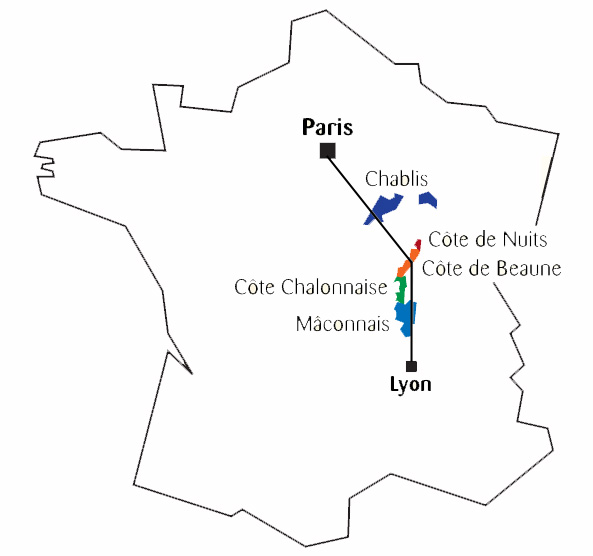 Bryce started by pointing out where exactly on the map we could
find white Burgundies. Essentially, they
come from the north-central part of France, but you can find them across
Flatbush Avenue or down on Seventh Avenue also.
Bryce started by pointing out where exactly on the map we could
find white Burgundies. Essentially, they
come from the north-central part of France, but you can find them across
Flatbush Avenue or down on Seventh Avenue also.
Of course the next step was to take the pre-lecture true or
false quiz. The answers to the first
four questions were "true". The answer
to the fifth question was "false". Oh
you want to know what the questions were?
Doesn’t matter, we got to start drinking anyway.
We then learned the importance of being classified higher up
in the hierarchy in the event a superstorm hits the region. It’s like being in Prospect Heights versus
Gowanus. Duh!
The first featured wine was a 2010 Les Heritiers du Comte
Lafon ($20). This is from the Mâcon area,
hence called a Mâcon-Villages. On the
first sip, one of the students started coughing uncontrollably. Another thought it like "butta". Go figure. This wine is aged in oak. After a
minute, some citrus began to come through. This wine is reportedly rich with lots of flavors like almonds, nuts or
flowers. No one was quite sure they
tasted these flavors, but probably the most helpful comment was: "I just know I like it."

.
The second wine was a 2011 Jacques Bourguignon Chablis ($10). This is considered a classic match with oysters, although for the less patient, clams work just as well. Unlike Mâcon vineyards, Chablis has grand cru wines. This means it should have more legs and more body. (I know what that’s like!) In the way of color, this wine had a slightly greener tinge, more like the control wine. It had more of a mineral, or even ashy, taste.
At this point, we stopped for a vote. Of the first three (the control and first two featured wines), all but one (who liked the Chablis) liked the Mâcon-Villages.
Our third wine was a 2009 Louis Latour Mersault ($35). This one seemed greener still. Louis likes to blend wines from a region as he is a shipper and not beholden to a particular vineyard. He also flash pasteurizes the wine. While this helps it stay in good shape longer, it also keeps it from improving with age. Vanilla was the give-away that it was aged in oak, and this one had even more of a butter taste. This goes better with fish in white sauce rather than shell fish. Participants seemed to like this better than any of the first three.
And for the final featured wine, we had a 2010 Louis Latour
Puligny-Montrachet ($42) from the Côtes du Beaune region of Burgundy. This was trés elegant for sure. It had a definite oaky nose and flavor. Supposedly it delivers the punch without the
price tag. (Hello?! It was the most expensive of the lot.) As for food pairings, it screams for lobster. A mild fish might be overwhelmed by the
Puligny-Montrachet. 
As between the Mersault and the Puligny-Montrachet,
preferences tipped toward the Puligny-Montrachet; just one person preferred the
Mersault. One would be happy with either
in a restaurant that did not serve both. (As far as I could tell, the same would hold true on a desert island for
that matter.)
Then we learned that the Mâcon-Villages was made by a person
with a Mersault background, and that is why we liked it so much better than the
Chablis.
So in the end, though the Mâcon-Villages and Puligny-Montrachet
were best of breed, the Puligny Montrachet was best in show.
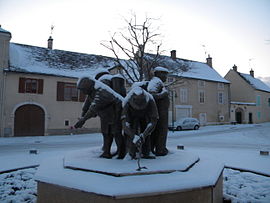 |
| Pouligny Montrachet |
 |
| Red Commune |
What did we learn from all this? The main thing is that not all communes are red!! Amazing.


Thursday, January 17, 2013
Older Wines . . . So What's the Big Deal?
Older Wines or “What’s the Big Deal?”
Montauk Club Wine Club Meeting, January 17, 2013
Our first gathering of the New Year focused on old wines. We've all heard supposed experts boast about opening that special bottle from long, long ago, but is it really worth it? Well, once again, we brought in our favorite expert, Bryce, to take us down the historical path. This was probably the most special meeting of the Wine Club ever as we were privileged to taste four vintages of a single wine – a Château Prieuré-Lichine. That is we tasted wines from the same region (Margaux, left bank) and same vineyard produced in 2009, 1999, 1988 and 1978. Trust me, this was a once in a lifetime opportunity to taste wines from this wide a range of vintages, so we all felt very special.

For those who had had a hard day or couldn't wait for the special vintages to be poured, we included a generic 2009 Bordeaux as a control wine. You’ll note that it shares the same age as the youngest of the featured wine. While we were having the featured wine poured, we started out looking at the color of the control wine. We found it to be purplish because of its relatively young age.
Then before we learned anything else, Bryce gave us a quick quiz. Whoever heard of taking a quiz at the beginning of a course? Just goes to show how unconventional Bryce can be. Here’s the quiz:
True or False?
Chateaus can produce as much wine as they want and bottle it under their own name.
Bordeaux vintners can irrigate the vines.
Chemicals and fertilizers are allowed.
98% of wine sold is consumed in 48 hours
Want to know the answers? Well you should have been there.
Bryce, having noticed that we were starting to tire of the preparation, then got us sipping. To really set the mood, he provided interesting historical context including recordings of the particular year’s top song. So here we go:
2009

"My Life Would Suck Without You" - Kelly Clarkson
As a youngster, this glass should have been light in tannin. We found some similarity to the control wine on that score. Compared to control wine, however, all said they’d prefer the Prieuré-Lichine even if Saturday involved a hard day of work followed by a drinking contest with people they didn't like. To compare the wines from a different angle, Bryce asked us to guess the price of the control wine. Guesses ranged from $7.99 to $20.00. The actual cost? About $7.00. In contrast, the 2009 Prieuré-Lichine costs between $50.00 and $60.00. Upon learning this, guests wanted to change their votes on which they would prefer to guzzle in order to forget their troubles. One guest, in order to be clear, said she liked it several times more than the control wine but not nine times more. We noticed that, with some air, the hidden tannin came out a bit more when tasting the Prieuré-Lichine a second time.
1999

"Believe" – Cher
This glass was browner than the 2009 – i.e. red, not purple – as a result of the tannins starting to disappear. At the same time this vintage seemed to have more fruit. One person thought it the 1999 still had more tannin than the 2009, but that’s just one person’s view. Everyone agreed that both vintages were nice, that is, that neither would insult your friends. The 1999 was plausible according to one guest. (The effusive praise just about killed the note-taker.) In the end we decided this was our least favorite of the four.
1988

"Faith" - George Michael
We found this vintage to be ver-r-r-ry interesting. (Someone went too far back in his time-machine, I’m afraid.) We thought it had darker tastes, and it was much browner than the 1999. We were seeing the tannin disappearing. (“Seeing”? Well, don’t forget, we’re on the fourth glass by now.) Anyway, as a result we tasted more fruit. We thought it little musty, but more complex. (Of course; go grab something that’s been in your attic for 25 years and see how musty it smells!) This seemed like a great wine to drink with sharp cheeses. It would be good with a beef steak, but might not be enough for a lamb unless it’s a rack of lamb. (Now we’re getting awfully discerning aren’t we?) Like a genie in the bottle, this older wine starts to do interesting things when it is exposed to air. (!) Someone had the audacity to suggest that the wine got more cheerful as you drank more. Bryce informed us that this was the year that Lichine, the proprietor of the vineyard, died and his son brought in some modern winemakers. Could that be the reason?
1978

"Shadow Dancing" - Andy Gibb
Now for the big test. This glass was quite a bit browner than the others. But to our surprise, some guests liked the 2009 better. We queried whether the 2009 might be somewhat rounder than the 1978 because winemakers are now making wines for immediate consumption. (Remember – modern winemakers, starting in the eighties? What d’ya expect?)At the end of the formal tasting, students were asked to try to put their glasses in date order (after mixing them up of course). Four students got at least two right. That’s what happens when you give the hard test after five glasses of wine.
So was it worth it? We think the answer is it depends on how hard your day has been, what you’re having to eat, etc., etc. Or to sum it up: you know it’s over the hill when the label makes promises the tannins can’t fill. But to find out if this is true, you have to open the bottle and drink a little, and for some that’s always worth it.
Subscribe to:
Posts (Atom)