White Burgundy – Again, What’s the
Big Deal?
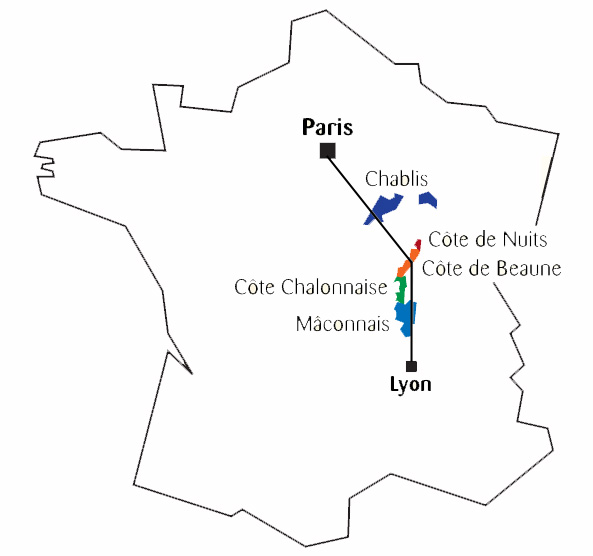 Bryce started by pointing out where exactly on the map we could
find white Burgundies. Essentially, they
come from the north-central part of France, but you can find them across
Flatbush Avenue or down on Seventh Avenue also.
Bryce started by pointing out where exactly on the map we could
find white Burgundies. Essentially, they
come from the north-central part of France, but you can find them across
Flatbush Avenue or down on Seventh Avenue also.
Of course the next step was to take the pre-lecture true or
false quiz. The answers to the first
four questions were "true". The answer
to the fifth question was "false". Oh
you want to know what the questions were?
Doesn’t matter, we got to start drinking anyway.
We then learned the importance of being classified higher up
in the hierarchy in the event a superstorm hits the region. It’s like being in Prospect Heights versus
Gowanus. Duh!
The first featured wine was a 2010 Les Heritiers du Comte
Lafon ($20). This is from the Mâcon area,
hence called a Mâcon-Villages. On the
first sip, one of the students started coughing uncontrollably. Another thought it like "butta". Go figure. This wine is aged in oak. After a
minute, some citrus began to come through. This wine is reportedly rich with lots of flavors like almonds, nuts or
flowers. No one was quite sure they
tasted these flavors, but probably the most helpful comment was: "I just know I like it."

.
The second wine was a 2011 Jacques Bourguignon Chablis ($10). This is considered a classic match with oysters, although for the less patient, clams work just as well. Unlike Mâcon vineyards, Chablis has grand cru wines. This means it should have more legs and more body. (I know what that’s like!) In the way of color, this wine had a slightly greener tinge, more like the control wine. It had more of a mineral, or even ashy, taste.
At this point, we stopped for a vote. Of the first three (the control and first two featured wines), all but one (who liked the Chablis) liked the Mâcon-Villages.
Our third wine was a 2009 Louis Latour Mersault ($35). This one seemed greener still. Louis likes to blend wines from a region as he is a shipper and not beholden to a particular vineyard. He also flash pasteurizes the wine. While this helps it stay in good shape longer, it also keeps it from improving with age. Vanilla was the give-away that it was aged in oak, and this one had even more of a butter taste. This goes better with fish in white sauce rather than shell fish. Participants seemed to like this better than any of the first three.
And for the final featured wine, we had a 2010 Louis Latour
Puligny-Montrachet ($42) from the Côtes du Beaune region of Burgundy. This was trés elegant for sure. It had a definite oaky nose and flavor. Supposedly it delivers the punch without the
price tag. (Hello?! It was the most expensive of the lot.) As for food pairings, it screams for lobster. A mild fish might be overwhelmed by the
Puligny-Montrachet. 
As between the Mersault and the Puligny-Montrachet,
preferences tipped toward the Puligny-Montrachet; just one person preferred the
Mersault. One would be happy with either
in a restaurant that did not serve both. (As far as I could tell, the same would hold true on a desert island for
that matter.)
Then we learned that the Mâcon-Villages was made by a person
with a Mersault background, and that is why we liked it so much better than the
Chablis.
So in the end, though the Mâcon-Villages and Puligny-Montrachet
were best of breed, the Puligny Montrachet was best in show.
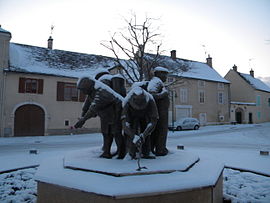 |
| Pouligny Montrachet |
 |
| Red Commune |
What did we learn from all this? The main thing is that not all communes are red!! Amazing.

